Forensic Documentary Note — Chapter 2
This chapter documents the decade following the 1968 institutional confrontation described in Chapter 1 — a period of deliberate reinvention that was neither random nor directionless, despite its apparent discontinuity from the preceding scientific career. The evidence presented here demonstrates a methodical transition: from academic medicine to information technology, funded and executed with the same analytical discipline that characterized the laboratory work.
The documentary record covers formal retraining at the Honeywell Institute of Information Sciences, seven years of applied scientific computing at the Metropolitan Water Reclamation District of Greater Chicago, informal access to Fermi National Accelerator Laboratory through personal connections, and the acquisition of tools — including an Apple II microcomputer — that would become instrumental in the academic career that followed.
The chapter also documents the role of community — specifically, the Chicago Little Italy neighborhood and its network of relationships — as the stabilizing infrastructure that made the transition possible. This is not incidental biography. It is part of the evidentiary record of how the career was rebuilt.
Foreword
The departure from the University of Illinois College of Medicine in 1968 was not a defeat. It was the beginning of a methodical reconstruction — built on the same discipline that had driven the laboratory work, applied now to the problem of rebuilding a professional life.
The institutional confrontation documented in Chapter 1 produced consequences that extended beyond the immediate loss of position. Lab access had been revoked. Pay had been delayed. Draft reclassification had created military service exposure during the Vietnam War. The ability to seek academic employment was constrained by the effective blacklisting from any position requiring a reference from the medical school. The classified nature of the CIA analytical work meant that the full context of the 1968 events could not be disclosed to prospective employers or colleagues.
What remained intact was the scientific method — the governing discipline of the career from its beginning. The challenge of 1968 was not a scientific problem. It was an institutional one. And institutional problems, like scientific ones, yield to systematic analysis, structured response, and patient execution of a plan.
Returning to Foundation: Little Italy and the Network of Reconstruction

After the departure from the University of Illinois Medical School, the immediate return was to the Chicago Little Italy neighborhood — not merely as a place of residence, but as a functioning support network. The decision was deliberate. In the academic and professional world, the blacklisting was effective. In the neighborhood, it was irrelevant.

Little Italy operated on a different currency than academic institutions — character, shared history, and demonstrated reliability mattered more than credentials or institutional affiliations. The network included Aldermanic allies and the influential Senator Roland Libonati, whose quiet support opened doors that official channels had closed. This community did not restore the laboratory or the faculty position. What it provided was more fundamental: the financial and social foundation from which the reconstruction could be planned and executed.
The professional goal was clear: formal retraining in information technology. The resources required for that retraining needed to be generated first. The path through Barnaby's franchise management to the Honeywell Institute was not a detour. It was the planned route.
Barnaby's Franchise Operations: 1969–1971
General Manager, Barnaby's Inc.
The position of General Manager at Barnaby's Inc. was accepted in 1969 as a deliberate financial strategy. The Honeywell Institute of Information Sciences offered a formal retraining program in computing that cost $2,000 — approximately $15,880 in current dollars. That capital needed to be generated. The Barnaby's position provided both income and operational management experience that would prove directly applicable to subsequent administrative roles.
Primary Source — Lerner Newspaper, Week of July 12, 1969
BARNABY'S, the authentic English pub at 2332 Devon, recently celebrated its official grand opening with festivities, gifts and prizes for the entire family. Ted Alexander is the director of training for Barnaby's Inc. and manager of the West Rogers Park restaurant. Bill Moressi is general manager. Barnaby's Inc. is a self-styled, fast food, family style, nationally franchised restaurant chain modeled after a 17th century English pub.
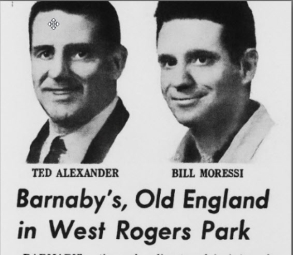
As General Manager, responsibilities covered operations across multiple locations, staff mentorship, and franchise consistency standards. The Barnaby's locations in operation at the time included West Rogers Park at 2332 Devon, Little Italy at 1614 Taylor, Niles at 7920 Caldwell, and Oakbrook Terrace on Summit Avenue south of Roosevelt Road.
Prior experience with the restaurant business had been limited to that of a customer. The management role was taken on not from familiarity but from necessity — and executed with the same systematic approach applied to laboratory work. The environment proved manageable. The income objective was met. By 1971, the Honeywell program was financially within reach.
Honeywell Institute of Information Sciences: 1971–1972
Post-Doctoral Studies in Information Sciences
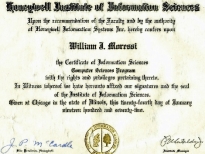
The Honeywell Institute of Information Sciences in downtown Chicago provided the formal retraining in computing that the transition required. Although prior computing experience existed — machine language programming on the LGP-30 at the University of Iowa, self-taught FORTRAN at Iowa and Illinois, and analog computer work throughout the biophysics research program — those skills had been acquired instrumentally, in the service of other scientific objectives. The Honeywell program provided systematic, industry-oriented training in the discipline as a professional field in its own right.
The curriculum covered programming in Assembler, COBOL, and FORTRAN; systems analysis and design; and computer operations and management. The capstone project involved designing, coding in COBOL, and implementing a complete business inventory control system — the first full-cycle information systems project in the record, and a direct precursor to the database and systems work that would define the next two decades.
The decision to pursue retraining at a professional institute rather than through an academic program was deliberate. The objective was not another degree. It was practical competency in an applied field, developed in an environment where computers were used for real business and scientific problems — not theoretical exercises. Honeywell provided exactly that.
Metropolitan Water Reclamation District of Greater Chicago: 1973–1979
Science Systems Information Analyst — Research & Development Department
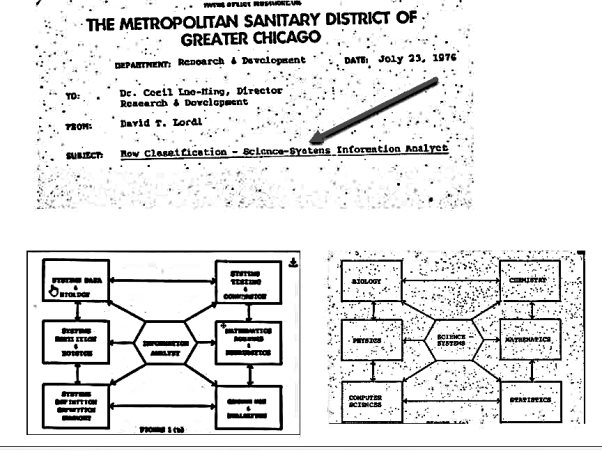
The position of Science Systems Information Analyst at the Metropolitan Water Reclamation District of Greater Chicago represented the first full integration of scientific training and computing competency in a single professional role. The MWRD's Research and Development Department monitored the environmental quality of Lake Michigan, area rivers and canals, and the Illinois River, documenting the effectiveness of the District's wastewater treatment program in compliance with U.S. Environmental Protection Agency regulations.
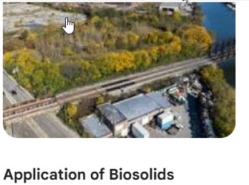
The central project of the MWRD tenure was the Prairie Plan — a nationally recognized land reclamation initiative that transformed 14,000 acres of strip-mined land in Fulton County, Illinois, into productive agricultural and recreational property through the application of MWRD biosolids. The project was awarded the Outstanding Civil Engineering Achievement Award by the American Society of Civil Engineers in 1974. The role within this project was that of the scientific data infrastructure: building, maintaining, and analyzing the environmental monitoring database that documented the program's effects over time.
The scientific rigor of the work was substantial. The database tracked nutrient levels — nitrogen and phosphorus — for groundwater impact assessment; trace metals including cadmium, copper, and mercury for leaching analysis; water quality parameters to establish baseline conditions; and dedicated groundwater monitoring wells sampled repeatedly over time to detect long-term changes. Statistical algorithms were coded into the database to calculate twelve-month moving averages and standard deviations, enabling the detection of significant changes in any monitored well, stream, reservoir, or lake. This was applied environmental science executed through information systems — exactly the synthesis the Honeywell training had been designed to enable.
Field work required regular travel to Fulton County to supervise environmental testing and sample storage operations. Test samples were packed in cold containers and shipped via Greyhound Package Express to downtown Chicago for laboratory analysis. The results were integrated into the database, and reports were supplied to the Illinois Environmental Protection Agency, the U.S. Public Health Service, the U.S. Geological Survey, and other agencies upon request.
Documented Technical Contributions — MWRD Period
- Converted all programs and data files of the Fulton County database from IBM systems (Service Bureau Corporation) to DEC systems (Compuserv) during 1976–1977; established the database system on in-house DEC minicomputers in the Engineering Department in 1978.
- Designed, developed, coded, and implemented the information system database for the Federal 208 Area Planning study in Illinois — covering inland lakes and Section 314 of the Clean Water Act (Federal Clean Lakes Program) — in collaboration with a co-analyst.
- Tested and implemented analytical equipment, including a microprocessor-controlled Technicon Auto-analyzer for cyanide analysis in chemical and technical applications.
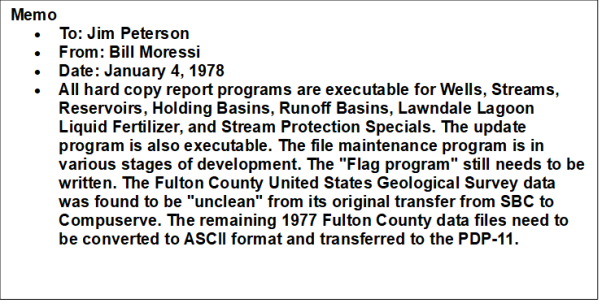
Internal MWRD memorandum documenting ongoing database management work — Fulton County Prairie Plan project.
Fermi National Accelerator Laboratory: Informal Access, 1970s
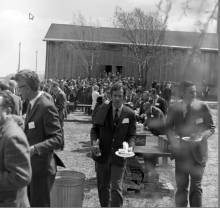
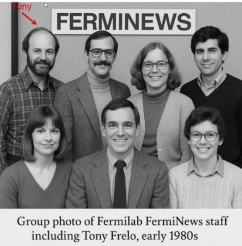
During the mid-1970s, informal access to Fermi National Accelerator Laboratory was maintained through a personal connection that originated in Chicago's Little Italy neighborhood — Anthony Frelo, a next-door neighbor from childhood who had become deeply involved in the laboratory's early operations. Frelo was an avid photographer and aviation enthusiast whose connections within the Fermilab community extended well beyond his formal role.
Through this connection, regular participation was possible in gatherings at the Kuhn Barn — a facility on the Fermilab grounds that served as an informal social hub for scientists, technicians, and staff. These gatherings provided access to the intellectual culture of one of the nation's most significant scientific institutions at a formative period in its development, and maintained the continuity of scientific community that the departure from academic medicine had disrupted. The Fermilab connection also reinforced the biophysics research background documented in Chapter 1, keeping those networks active through a period when formal institutional affiliation had been lost.
The Apple II Acquisition: 1977

In 1977, a shared purchase was made with two MWRD colleagues — a chemist and a physicist — of an Apple II microcomputer system configured with maximum memory, two floppy disk drives, a business-grade dot-matrix printer, and supporting software. The total cost of approximately $4,500 was divided equally among the three. The Apple II represented a significant investment at the time, and the decision to acquire it was deliberate rather than speculative — it was a professional tool purchased in anticipation of consulting applications.
When the consulting arrangement with the colleagues dissolved, the system was purchased outright through a personal loan. That decision proved consequential. The Apple II — with BASIC for programming, VisiCalc for spreadsheet analysis, and WordStar for word processing — became the primary productivity platform for the work at Johnson C. Smith University that followed. Grant applications, system proposals, and departmental documentation at JCSU were all produced on this machine. The 1977 purchase was, in retrospect, an investment in the infrastructure of the next phase of the career.
1979: The Return to Academic Administration
The departure from MWRD was not planned. It was precipitated by a contact from former graduate school colleagues who had assumed senior administrative positions at Johnson C. Smith University in Charlotte, North Carolina. The university's Data Processing Department — three full-time employees — had threatened to resign en masse over payroll demands, placing the institution in an operational crisis. The colleagues asked whether the situation could be assessed and, if the staff departed, whether their functions could be assumed.
The decision to accept required only brief consideration. A leave of absence from MWRD was secured — made feasible by the redundancy built into the three-person R&D team and by the sponsorship relationships that had supported the original transition. The offer from JCSU included complete operational control of the Data Processing Department as Director, an associate professorship in computer science, faculty support from the Computer Science Department, and access to student staff. It was, in precise terms, the opportunity that the Honeywell retraining and the MWRD computing experience had been building toward.
The transition from MWRD to JCSU completed the decade-long arc from the 1968 departure. A career that had been dismantled by institutional coercion had been rebuilt — through systematic retraining, applied scientific computing, and the maintenance of professional and personal networks — into a position of institutional leadership. The methodology was the same one applied in the laboratory. The domain had changed. The discipline had not.
Archival Note
The memos and documents cited throughout this chapter are drawn from personal work records maintained across the MWRD period. They are presented as primary source evidence supporting the accuracy of the chronological record and reflecting the professional environment of the 1973–1979 period.
Forensic Summary: What the Evidence Demonstrates
The decade 1968–1979 was not a period of aimless drift following institutional defeat. The evidence — Barnaby's management, Honeywell retraining, MWRD scientific computing, Apple II acquisition, Fermilab access — documents a systematic reconstruction executed in logical sequence. Each step built the foundation for the next. The scientific method applied to career rebuilding produces the same kind of structured, evidence-based progress it produces in the laboratory.
The MWRD record — federal agency reporting, database system conversion, Federal 208 Area Planning implementation, Prairie Plan environmental monitoring — constitutes a documented portfolio of applied scientific computing at a professional level. These are not incidental skills. They are the direct predecessors of the database and systems work that defined the academic IT leadership at JCSU, Winthrop, and NEIU.
The Little Italy network — Senator Libonati, Aldermanic allies, neighborhood relationships — provided the stabilizing foundation that made the transition possible when institutional channels were closed. The Fermilab access through Anthony Frelo maintained scientific community continuity. These relationships are part of the evidentiary record, not peripheral biography.
The 1977 Apple II purchase — made at personal financial risk through a loan — proved to be a career-defining investment. The machine became the primary tool for professional productivity at JCSU and the demonstrable proof of the computing competency that the academic career required. The decision to acquire and retain it reflects the same forward-planning discipline documented throughout the record.
The transition from biophysicist to computing professional was not a change of discipline. It was an application of the same analytical framework to a new domain. The scientist who quantified microwave effects on biological tissue also quantified environmental contaminants in groundwater and coded the statistical algorithms to detect anomalies in both. The method — define the problem, measure the evidence, build the model, state the conclusion — remained constant across every context in which it was applied.
The decade between 1968 and 1979 demonstrates that the scientific method is not confined to the laboratory. Applied to the problem of rebuilding a career under adverse conditions, it produces the same result it produces everywhere else: a verifiable record of systematic progress toward a defined objective.