Forensic Documentary Note — Chapter 4
This chapter documents eleven years at Winthrop University — the longest single institutional tenure in the documentary record prior to NEIU, and the period in which the operational methodology first proven at JCSU was articulated formally as a strategic framework. The 1989 CAUSE national conference paper "Towards Negative Entropy: A Strategic Plan" — co-authored and presented during the Winthrop tenure — named the methodology that would govern the NEIU work and define the documentary's analytical spine.
The evidentiary record is substantial: the WinNet campus network initiative (1987–1991), the NSF NSFNET grant (1992–1994), eleven years of documented teaching across multiple disciplines, two presidential leadership roles in professional organizations, a significant publications record, and formal recognition from institutional, state, and national bodies.
The chapter also presents the most analytically explicit section of the documentary — a structured forensic analysis applying the Analysis of Competing Hypotheses (ACH) methodology to two questions of institutional advancement. That analysis is preserved here exactly as developed, as a demonstration of the forensic method applied to the subject's own career record.
Foreword
The Winthrop years were defined by a productive tension — between the scale of what was being built and the institutional constraints on how far that building could advance the career within the institution itself.
From 1984 to 1995, the role was Director of Academic Computing and Associate Professor of Computer Science at Winthrop University in Rock Hill, South Carolina. The work was substantial by any objective measure: a campus-wide network built from nothing, a National Science Foundation grant secured, policies developed that were adopted nationally, professional organizations led at the state level, and a teaching record spanning computer science, management information systems, statistics, biostatistics, and environmental science.
The tension was not with the work itself. It was with the institutional framework that governed advancement — a framework that evaluated applied computing leadership and campus infrastructure achievement through criteria calibrated for a different kind of scholarly productivity. The forensic analysis at the end of this chapter examines that tension directly, with the same evidentiary discipline applied throughout the documentary.
Winthrop University: 1984–1995
Director of Academic Computing / Associate Professor of Computer Science

Winthrop University is a public institution in Rock Hill, South Carolina, offering 80 undergraduate and 41 graduate degree programs, accredited by the Southern Association of Colleges and Schools. During the 1984–1995 tenure period, the campus community included over 5,000 students and more than 500 faculty and staff members. All academic programs held national accreditation in their respective fields — a standard that the IT infrastructure of the institution was required to support.
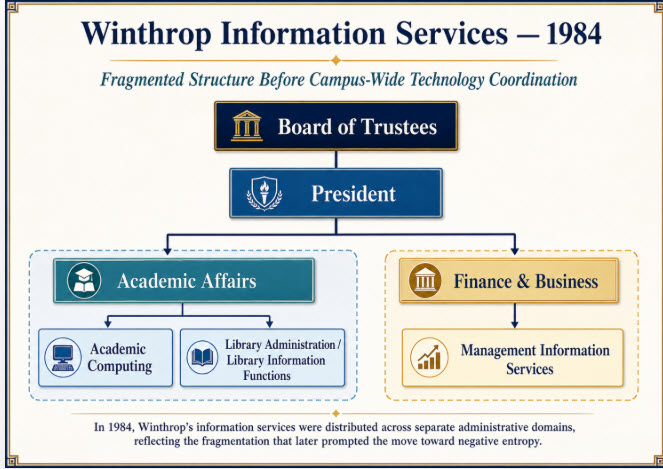
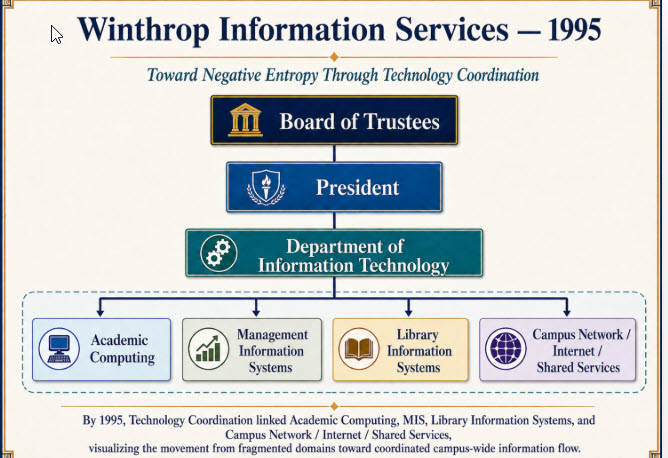
The scope of the role encompassed management of Academic Computing, Media Services, and Distance Education — the full range of instructional technology functions across the institution. The organizational structure was built, the staff positions were defined and filled, the technical standards were established, and the infrastructure was implemented. Over eleven years, the computing environment at Winthrop was transformed from a collection of disconnected departmental systems into a standards-based, networked campus infrastructure connected to the national academic internet.
Core Responsibilities — Winthrop 1984–1995
- Managed Academic Computing, Media Services, and Distance Education departments.
- Established organizational structure and filled all positions in the Academic Computing Department.
- Planned, secured funding for, and implemented the campus Local Area Network and subsequent infrastructure updates.
- Served as Principal Investigator for the NSF grant connecting the Winthrop campus LAN to the national internet backbone.
- Led the project team in creating the campus Acceptable Use Policy and Policy on Copyright Law.
- Contributed to development of the campus-wide Computer Literacy instruction program.
- Taught graduate courses in computer literacy, economic statistics, management information systems, and special topic research in business administration.
WinNet (1987–1991): From Concept to Campus Infrastructure
The WinNet initiative was the defining infrastructure project of the Winthrop tenure. Conceived in 1987 by the Computer Utilization Committee and developed through the Network Project Team (NPT) under the chair of William J. Moressi, WinNet addressed a fundamental institutional problem: Winthrop's information environment was fragmented across incompatible systems with non-standard cabling, limited conduit capacity, and interoperability gaps that prevented effective communication and data sharing across academic and administrative units.
WinNet Milestones — 1987 to 1991
- 1987: IT census and feasibility study conducted; two-year and five-year fiber infrastructure plans defined.
- 1988: Vendor consultations completed; telephone and data line inventory revealed critical shortfalls in existing capacity.
- 1989: WinNet proposal submitted requesting $2.17 million in supplemental state funding.
- 1990: Board of Trustees adoption of the WinNet plan; IT units reorganized into the Division of Information Management; Network Administrator and Systems Engineer roles created.
- 1991: Computing Infrastructure RFP released; wiring bids issued; physical installation of the standards-based network commenced.
The result of the WinNet initiative was the governance framework, funding pathway, and technical standards that made campus-wide networking feasible — and that provided the foundation for the NSF internet connection that followed. The "Towards Negative Entropy" paper presented at the 1989 CAUSE national conference in San Diego documented this strategic planning methodology explicitly — the first formal articulation of the framework that would be applied at full institutional scale at NEIU.
NSFNET Grant NCR-9119820 (1992–1994): Winthrop's First Internet Connection
The National Science Foundation Network Infrastructure grant, effective April 15, 1992, provided $30,000 toward a total program budget of $110,920 over five years — with an institutional match of $80,920 in cash and in-kind contributions. The grant's scope was specific: to provide Winthrop College's initial high-speed connection to the NSF internet backbone (NSFNET), enabling faculty and student access while coordinating with the developing WinNet campus infrastructure.
Principal Investigator: William J. Moressi, Academic Computing. Project direction shared with William I. Thacker, Computer Science. NSF review ratings: "Very Good" and "Good." Reviewers noted significant undergraduate impact; the external internet link was prioritized while on-campus networking continued to mature under WinNet.
The result placed Winthrop on the national academic network — among the earlier institutions in South Carolina to achieve this connection — and demonstrated institutional commitment to sustained internet connectivity at a time when many comparable institutions had not yet begun the process.
Teaching Record: 1984–1995
Winthrop University Teaching Timeline
- 1986–1988: CSCI 101, 211, and 212 — updated with current hardware including IBM PC/AT and modern networking technology.
- Spring 1988: Special topics course in Novell NetWare networking — practical local network management skills concurrent with campus network expansion.
- Fall 1987: Two-semester sequence in statistical methods and probability theory — data summaries, distributions, hypothesis testing, combinatorics, and random variables.
- Fall 1988: Management Information Systems curriculum — computing applications in business operations, management decisions, and organizational productivity.
- Fall 1989: Systems Analysis — software development through diagrams, models, and simulated client interviews.
- 1990–1992: Special topics including AI Expert Systems, multimedia design, and IT Media copyright law.
- 1993–1995: Instructional Design and Multimedia — early multimedia tools for educational software and user interface development.
Adjunct Teaching — Other Institutions
Medical University of South Carolina (January–April 1992): Biostatistics and Research Methodology (Course 005-440D), delivered at York Technical College in Rock Hill. The course emphasized data analysis techniques in healthcare, with an independent research project requirement. Student evaluations documented clear organization, accessible instruction, and willingness to provide additional support for students needing algebraic review.
Limestone College (May 2–30, 1995): Environmental Science (BI107), Fort Mill, SC location. Monday, Tuesday, and Thursday evenings, 6:00–9:20 PM. Science education extended to a community college audience — a direct continuation of the public science engagement that had characterized the career since the early teaching years at Iowa.
Publications and Presentations: 1984–1995
Peer-Reviewed National Conference Presentations
- Moressi, W.J., Haynsworth, H.C., & Ward, E. (1995). Education, Experience, and Training Attributes of Information Center Personnel in Education. Poster Presentation, CAUSE National Conference, New Orleans, LA.
- Moressi, W.J. & Rosen, J. (1994). Legal and Ethical Use of the Internet. 14th Annual Higher Education Network Association Conference, Myrtle Beach, SC.
- Moressi, W.J. & McCauley, R.E. (1994). An Expert System Prototype: Copyright Law in a Multimedia Environment. ASCUE National Conference, Myrtle Beach, SC.
- Moressi, W.J. & Curry, J.R. (1992). Multimedia: IC Personnel Support in the Instructional Area. Association for Applied and Interactive Multimedia Conference, Charleston, SC.
- Moressi, W.J. & Laster, B.M. (1990). A College Policy on Copyrighted Material. CAUSE National Conference, Miami Beach, FL.
- Moressi, W.J. & McFadden, C.B. (1989). From Connectivity to Interoperability. CAUSE/EFFECT, 12(4), 47.
- Moressi, W.J., Laster, B.M., Mitlin, L.R., & McFadden, C.B. (1989). Toward Negative Entropy: A Strategic Plan. CAUSE National Conference, San Diego, CA.
▶ Listen to the original 1989 conference presentation (audio recording) - Price, B.A., Archer, C.B., & Moressi, W.J. (1988). A Successful Approach to the Computer Literacy Course. SIGCSE Bulletin, 20(2).
- Moressi, W.J. & McFadden, C.B. (1988). Step 2: Of Bridges and Gateways: Linking Winthrop's Novell NetWare LANs. CAUSE National Conference, Nashville, TN.
- Moressi, W.J. & McFadden, C.B. (1987). Students as Academic Computer Center Personnel. CAUSE/EFFECT, 10(4), 14.
- Moressi, W.J. & McFadden, C.B. (1987). The Development of a Successful Microcomputer Network Operation: Winthrop College's Novell LANs. CAUSE National Conference, Tarpon Springs, FL.
State, Regional, and Institutional Publications
- Moressi, W.J. (1993). A Focus on the Training and Experience of IC Personnel in Education. 12th Annual HENA Conference, Myrtle Beach, SC.
- Moressi, W.J. (1991). A College Policy on Copyrighted Material, Ver. 2. 11th Annual HENA Conference, Charleston, SC.
- Moressi, W.J. (1990). Environmental Impact from Expanded LAN Connectivity. 10th Annual HENA Conference, Charleston, SC.
- Moressi, W.J. (1988). Computer Literacy Toolbox: Three Skills for Productivity. The Herald (Rock Hill, SC), February 28, 1988, p. 10B.
- Moressi, W.J. & McFadden, C.B. (1986). Administrative and Technical Management of a Small Academic Computer Center. 6th Annual HENA Conference, Myrtle Beach, SC.
Organizational Leadership
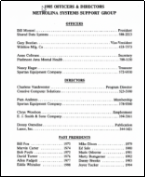
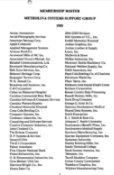
Metrolina Systems Support Group — President, 1985
The Metrolina Systems Support Group, founded in 1972, was a regional alliance of IBM mid-range computing system users in the Charlotte metropolitan area. By 1985, the organization encompassed 76 active member companies across manufacturing, services, retail, healthcare, and government. As President, responsibilities included chairing the Board of Directors, presiding over all meetings, and guiding the organization's mission of promoting data processing as a profession and facilitating cooperation among users of IBM System/3, System/34, System/36, and System/38 platforms.
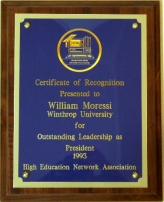
SC Higher Education Network Association (HENA) — President, 1993
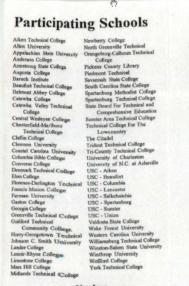
The Higher Education Network Association was a South Carolina non-profit organization connecting post-secondary education professionals engaged with technological and instructional computing advances. Established in 1980, HENA had grown to over 150 members by 1993, drawn from public and private two-year and four-year colleges, universities, and technical colleges across South Carolina. The Executive Board — President, Vice President, Secretary, Treasurer, six elected Board Members, and Immediate Past President — managed policy, finance, and the annual conference program.
Awards and Recognition: 1984–1995
- 1985–1986 Winthrop College Distinguished Service Citation — Formal recognition for extensive assistance in computerizing Winthrop College, acknowledging the foundational infrastructure work undertaken in the first years of the appointment.
- May 9, 1985 UNCC Certificate in PC LAN — Continuing education completion, UNC Charlotte, IBM PC networking program. An early technical credential reinforcing the computing competency applied throughout the Winthrop tenure.
- May 30, 1986 Exemplary Service to School and Community — Computer Advisory Board recognition, alongside colleagues Jim Crook and Barbara Price, for contributions to the Computer Science Program and community engagement.
- August 28, 1986 Note from Assistant to the President — Personal acknowledgment from the Assistant to the President for Institutional Planning recognizing the Academic Computer Center and its leadership during a period of rapid growth.
- February 2, 1988 Winthrop Student Employment Program Recognition — The Academic Computer Center recognized for outstanding service to student employment, reflecting the dual mission of technical excellence and student mentorship.
- 1988–1991 CAUSE Editorial Committee Service — Three-year appointment to the Editorial Committee of CAUSE, the national association for IT management in higher education. Recognized with a certificate and personal letter from editor Julia Rudy upon completion of service.
- February 6, 1991 CAUSE Exchange Library Contribution — Winthrop's College Policy on Copyrighted Material submitted, accepted, and distributed nationwide through the CAUSE Exchange Library — a formal contribution to intellectual property policy in American higher education.
- October 30, 1990 Inaugural Steering Committee Recognition — President DiGiorgio's formal thanks for organizing Winthrop's inaugural events during National Higher Education Week, including guest logistics and communications coordination.
- May 11–13, 1992 York Technical College VAX/VMS Certificate — Technical completion in VAX/VMS systems, directly supporting enterprise system management responsibilities in academic computing.
- April 26, 1995 State of South Carolina 10-Year Service Award — Presented at Winthrop's Faculty, Staff, and Retirees Awards Ceremony, signed by the Governor of South Carolina, for over ten years of dedicated service to the state institution.
News and Noteworthy Events
The 1986 Kinard Hall Fire
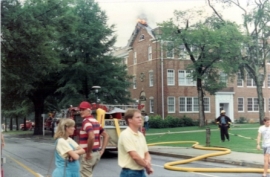
On August 11, 1986, Kinard Hall — which housed both the School of Business Administration and the Academic Computing Center — was struck by lightning during an electrical storm. The attic of the building caught fire; the roof was destroyed by the fire itself, while the remainder of the building sustained significant water damage from rain and firefighting operations. Offices and students were displaced, and academic operations were disrupted while cleanup and assessment proceeded.
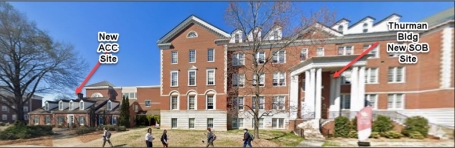
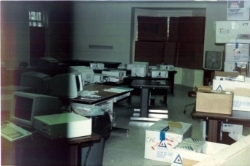
Recovery required nearly two years before the building was fully operational again. Rededication occurred on March 28, 1988, with the unveiling of a portrait of the building's namesake, James Pinckney Kinard, in the main lobby. In the interim, the School of Business Administration relocated to the Thurman Building, and the Academic Computing Center to the adjacent McFeat Nursery building. In collaboration with colleague Brown McFadden — an electrical engineer with an MBA from Winthrop — the complete retrofit of the McFeat building was planned and executed. Computing classes were operational in time for the Fall 1986 semester.
Hurricane Hugo: September 22, 1989
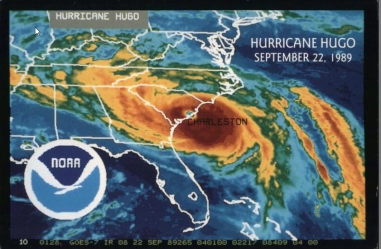
In the early morning hours of September 22, 1989, Hurricane Hugo struck Rock Hill, South Carolina — approximately 25 miles south of Charlotte. Hugo maintained Category 1 intensity at Rock Hill with sustained winds exceeding 80 mph and gusts above 90 mph, hitting between 3:30 and 4:00 a.m. Eastern Time. Winthrop sustained significant damage: power was lost, trees were down across campus, and computing facilities were inaccessible. Academic operations halted.
Recovery proceeded systematically. Once campus safety was confirmed, the network engineer, physical plant staff, and the Academic Computing directorship focused on restoring access to the IT systems on which faculty and students depended. Power was restored to Winthrop ahead of much of the surrounding city, enabling academic operations to resume more quickly than was possible at many affected institutions. The Johnsonian student newspaper documented the recovery week by week across October and November 1989 — a contemporaneous record of the disruption and the institutional response that constitutes part of the documentary evidence for this period.
Selected Media and Institutional Documentation

Winthrop News Faculty Highlights, 1985–1986 — documenting the faculty community's publishing, presenting, and curriculum activity during this period.

April 23, 1986 — Presidential Citation: Dr. Bill Moressi received a Presidential Citation for service to Winthrop College, acknowledged specifically for dedication in providing computer services to faculty, students, and staff.
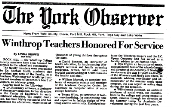
April 25, 1986 — The York Observer, "Teaching Honors": Regional recognition of educators for dedication to teaching excellence, integrity, mentorship, and academic rigor.
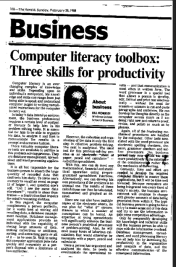
February 28, 1988 — The Herald Sunday: "Computer Skills Toolbox: Three Skills for Productivity" — a public-facing article arguing that modern business professionals require computer literacy in database management, electronic spreadsheets, and word processing. Published in the Rock Hill regional paper, reaching beyond the academic community.
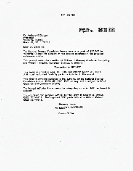
April 29, 1992 — WU FYI: Internal university communication documenting the NSF grant award for internet connectivity — the institutional record of the NSFNET connection that placed Winthrop on the national academic network.
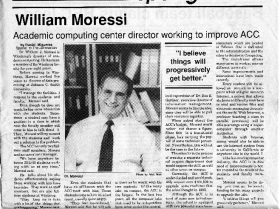
March 31, 1993 — The Johnsonian, "ACC Director Improves Department": Student newspaper coverage of Academic Computing Center modernization efforts, documenting improvements in student access and technical support responsiveness.
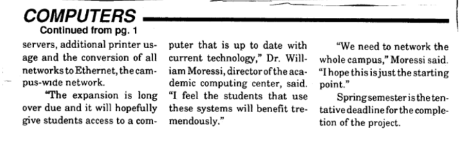
September 8, 1993 — The Johnsonian, "ACC Labs": Coverage of computing lab upgrades ensuring equitable student access to digital resources across departments.
1993 — WUSBA Business Report: Documentation of how business students were adapting to internet technologies as a result of the NSF-funded connectivity, bridging traditional coursework with emerging digital tools.
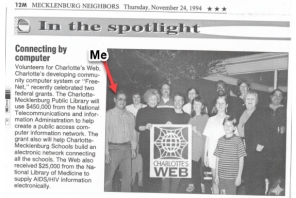
November 24, 1994 — Mecklenburg Neighbors, "Charlotte's Web": Coverage of volunteer involvement with Charlotte's Web — Charlotte's developing community Free-Net system. Two federal grants were received: $450,000 from the National Telecommunications and Information Administration for a public access computer information network, and $25,000 from the National Library of Medicine for AIDS/HIV information access.
June 20, 1995 — The York Observer, "Winthrop's Web Page": Coverage of Winthrop's launch of a World Wide Web homepage providing public access to admissions, course, and campus information. The Academic Computing directorship is cited as supporting the site's development and campus use — one of the final documented contributions of the Winthrop tenure before the transition to NEIU.
Other Associated Activities
Edu-Tek — President and Co-Owner, 1988–1995
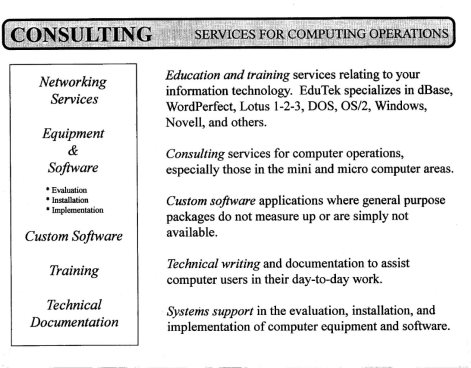
EduTek was a full-service technology company operating primarily in the Carolinas, offering networking setup and installation, hardware and software evaluation and implementation, custom software development, education and training, and technical documentation. The full-time team consisted of the President and two co-owners — a Computer Electrical Engineer and a Computer Software Engineer. Student staff from the Winthrop Computer Science and Business programs — typically 10 to 15 at any given time — were hired for business assignments, providing them with documented commercial work experience for their resumes.
Clients included Allied Payroll (SC), Carolina Staffing Inc. (SC), Catawba Rehabilitation Services (SC), City of Rock Hill (SC), Health Sciences Division of the University of Texas at San Antonio (TX), Medical University of South Carolina, Pony Express Courier Corp of Charlotte (NC), The Tuttle Company Inc. (SC), Winthrop University's Joynes Conference Center and Department of College Relations, and York County Natural Gas Authority (SC).
Small Business Development Center — Consultant, 1986–1993

Consulting through the Small Business Development Centers at Winthrop University (Rock Hill, SC) and Francis Marion University (Florence, SC) provided IT advisory services to small businesses starting and sustaining operations in the region. This work extended the applied technology expertise developed at Winthrop into direct community economic service — a practical application of the same computing knowledge being taught and administered within the university.
Professional Society Memberships
Association for Computing Machinery (ACM): Active membership during the 1980s and 1990s, providing access to advances in computer science at a time when digital methods were transforming research and practice across disciplines.

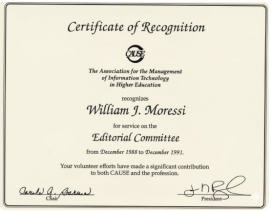
College and University Systems Exchange (CAUSE): Significant national involvement including Editorial Committee service (1988–1991), multiple national conference presentations (1987–1995), and submission of the Winthrop copyright policy to the CAUSE Exchange Library for national distribution.

Institute of Electrical and Electronics Engineers (IEEE): Membership during the 1980s and 1990s providing access to technical journals, conference proceedings, and evolving standards driving the transformation of computing, electronics, and communications.

Biophysical Society of America: Continuous membership from the 1960s through the 1990s, maintaining active connection to developments in radiation biology, cellular physiology, and computational approaches — a deliberate preservation of the scientific foundation established in Chapter 1 throughout the technology career documented in Chapters 2 through 5.
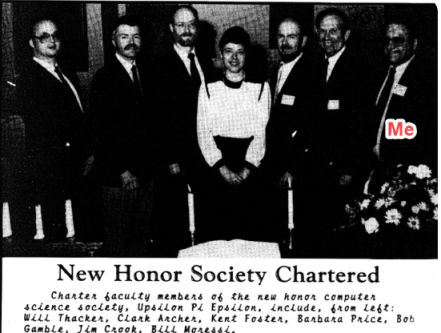

Upsilon Pi Epsilon (UPE) Computing Sciences Honor Society: Membership since 1968 — the year the society was founded. Membership in UPE's inaugural cohort placed the subject among the first scholars to be formally recognized for excellence in the newly established field of computer and information disciplines, at the precise moment of career transition from academic medicine to information technology.
Forensic Analysis: The Question of Institutional Advancement
The Winthrop tenure produced a documented record of institutional achievement: a campus network built from nothing, a national grant secured, policies developed and adopted nationally, organizations led at the state level, and eleven years of teaching across multiple disciplines. Against that record, two institutional advancement outcomes — administrative and academic — did not materialize. The question of why is examined here using the Analysis of Competing Hypotheses methodology applied throughout this documentary.
Administrative Advancement — ACH Analysis
Administrative Advancement — Analysis of Competing Hypotheses
Benchmark requirements (administrative): Completed doctoral degree; prior system-level IT planning and oversight across academic and administrative units; prior leadership of an administrative computing organization; authorship and implementation of IT policies, standards, and long-range plans; sustained professional engagement and leadership in higher-education IT.
Three competing hypotheses examined:
(1) Role classification and timing prevented advancement through the standard process — specifically, the director role was classified in a way that precluded application through the normal administrative search channel, and the 1995 search proceeded without the position being advanced to interview.
(2) The institution's process design effectively closed the advancement path — the committee structure placed the director in an evaluative rather than candidate role when relevant positions opened.
(3) Qualifications were insufficient to meet the administrative benchmark.
Evidence tested against each hypothesis: WinNet 1987–1991 (Board of Trustees adoption); NSFNET award 1992–1994; prior administrative computing directorship at JCSU 1979–1984; Kinard fire operational leadership 1986; Hurricane Hugo IT recovery 1989; 1995 administrative search in which advancement to interview did not occur.
Conclusion: The record most strongly supports that role classification and institutional process design constrained advancement. "Insufficient administrative qualifications" is the least supported explanation given the documented evidence. Method: structured comparison modeled on ACH, using only dated items cited in this chapter.
Academic Tenure — ACH Analysis
Academic Tenure — Analysis of Competing Hypotheses
Field context: In Computer Science broadly, peer-reviewed conference presentations and journal publications both carry weight; applied and integrative work can count when peer-scrutinized or externally validated. The local Winthrop policy applied a narrower standard: a journal-heavy five-year publication count in CS and Quantitative Methods, with major IT and infrastructure work credited as service rather than research output.
Tenure condition: Within a single five-year window: five or more peer-reviewed publications in CS/QM, including at least one journal article, evidencing an ongoing research program. Status: this condition was not met under the local policy definition.
Three competing hypotheses examined:
(1) Role classification as director rather than tenure-track faculty precluded the tenure pathway from the outset.
(2) The department's local publication rule set a narrower bar than standard CS field norms — crediting infrastructure work as service rather than research output.
(3) The scholarly record did not meet the department's tenure condition.
Evidence tested: The five-in-five local rule; ACM SIGCSE Bulletin 1988; CAUSE/EFFECT 1989; national conference proceedings 1989–1994; the administrative memo classifying the director role as non-tenure-track; teaching and service records documenting the volume of applied contributions.
Conclusion: Under the local publication rule, the tenure condition was not met. Role classification also constrained the pathway independently of publication record. This is analytically separate from administrative readiness and does not imply a global qualifications shortfall outside the specific local rule. Method: structured comparison modeled on ACH, using only dated items cited in this chapter.
Forensic Summary: What the Evidence Demonstrates
The WinNet initiative and the NSF NSFNET grant constitute a documented record of campus-wide infrastructure transformation — from fragmented, incompatible systems to a standards-based network connected to the national academic internet. These achievements are primary-source verified through Board of Trustees records, NSF grant documentation, and contemporaneous media coverage.
The 1989 CAUSE paper "Towards Negative Entropy: A Strategic Plan" is the formal articulation of the methodology that governs this documentary. Developed at Winthrop, documented at a national conference, and applied subsequently at NEIU on a larger institutional scale, it represents the explicit bridge between the scientific training of Chapter 1 and the institutional leadership of Chapter 5.
Winthrop's Policy on Copyrighted Material, submitted to the CAUSE Exchange Library in 1991 and distributed nationally, constitutes a verified contribution to intellectual property policy in American higher education — a policy achievement that extended the impact of the Winthrop work beyond the institution itself.
The ACH analyses presented above reach conclusions supported by the evidentiary record: role classification and institutional process design were the primary constraints on administrative advancement; the local publication rule was the primary constraint on academic tenure, independently of the applied computing record. Neither conclusion requires attributing inadequacy to the subject. Both conclusions are supported by dated documentary evidence and reach their results through structured comparative analysis rather than assertion.
The work at Winthrop established the proof of concept that was applied at full scale at Northeastern Illinois University. The pattern — diagnose institutional entropy, build governance, implement standards, document results — was proven at Winthrop and deployed with greater scope and authority at NEIU. Chapter 5 is the culmination. Chapter 4 is the preparation.
The ladder was strong. It was leaning against the right wall. The question of where it led next was answered by Northeastern Illinois University in 1995.