Forensic Documentary Note — Chapter 5
This chapter is the culmination of the documentary. It presents the full-scale institutional application of the methodology developed, named, and proven across the preceding four chapters — from the scientific discipline established in Chapter 1, through the reinvention of Chapter 2, through the foundational institution-building of Chapters 3 and 4, to the largest and most consequential deployment of the "Towards Negative Entropy" framework in the record.
The evidentiary record here is the most comprehensive in the documentary: organizational charts reconstructed from institutional data, photographic documentation of thirteen computer labs and four Technology Enhanced Classrooms, primary-source records of policy authorship, named recognition in institutional documents, and the contrast between the fragmented IT structure of 1995 and the substantially more unified technology organization that developed during the 1995–2004 period and subsequently evolved into NEIU’s CIO-led structure.
One staff member in January 1995. One hundred and fifty personnel at retirement in June 2004. The evidence speaks for itself.
Transforming a Fragmented Institution into a Unified Technology Division
Foreword
By 1995, I had seen this problem before.
At Winthrop University, I had spent nearly a decade diagnosing and correcting exactly the kind of institutional disorder that results when information technology grows without coordination — fragmented systems, incompatible protocols, no standards, no unified governance. The 1989 CAUSE national conference paper I co-authored, Towards Negative Entropy: A Strategic Plan, documented that disorder and the methodology we used to reverse it. The Second Law of Thermodynamics is unambiguous: without organized information flow, any system drifts toward disorder. A university campus is no different from any other living system in this respect.
When I interviewed for the Director of Academic Computing position at Northeastern Illinois University in Chicago, the review committee's questions confirmed what I suspected: NEIU had the same problem. IT functions were distributed across competing organizational units with no central coordination, no shared standards, and significant political friction between them. The situation was familiar. So was the solution.
What was not familiar was the scale of what would be asked of me — and what I would ultimately build.
My Experience at NEIU
Director of Academic Computing (1995–2000) / Executive Director of University Computing (2000–2004)
Northeastern Illinois University, Chicago, Illinois
Northeastern Illinois University is a comprehensive public institution serving approximately 10,400 students with 932 faculty and staff. It offers more than 80 undergraduate and graduate programs across three distinct campuses: the main 67-acre campus on St. Louis Avenue in North Park; El Centro in Avondale, providing outreach and general education for the Latino community; and the Jacob H. Carruthers Center in historic Bronzeville, a premier African-centered institution for Urban Community Studies. Connecting and serving all three campuses equitably was not simply a technical challenge. It was a scientific and organizational one.
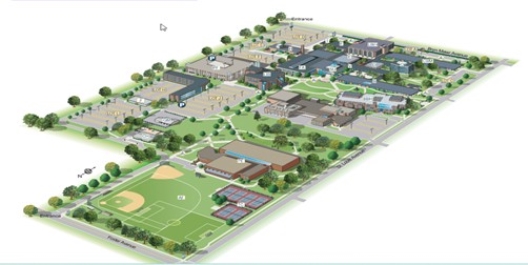
NEIU Main Campus — aerial view of the 67-acre North Park site, Chicago, Illinois.
The Technology Landscape at NEIU in 1995: The Evidence of Disorder
To understand what I was asked to do, it is necessary to understand what I found. The organizational chart below was reconstructed from institutional records and research data gathered on NEIU. It illustrates the fragmented IT reporting structure that existed when I arrived in January 1995.
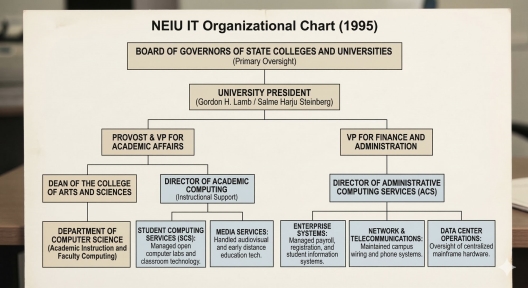
NEIU IT Organizational Chart, 1995. Reconstructed from institutional records and research data. Illustrates the fragmented reporting structure — Academic Computing and Administrative Computing Services under entirely separate chains of command — that existed prior to reorganization.
In 1995, NEIU's information technology was not a unified function. It was a collection of competing units, each with its own reporting lines, budget, and territorial interests. My position — Director of Academic Computing — reported to the Provost and VP for Academic Affairs. The Director of Administrative Computing Services reported entirely separately to the VP for Finance and Administration. Network and Telecommunications, Media Services, and Data Center Operations each had their own structures. There was no Chief Information Officer. There was no unified governance. There was, in the language of my 1989 CAUSE paper, significant institutional entropy.
The technology itself reflected this disorder. The university's administrative backbone ran on an IBM 3090 mainframe. Student records were managed through ISIS, a menu-driven host-based system. Campus networking relied on Novell NetWare for file sharing and print services. Student labs contained a chaotic mix of Apple Macintosh systems alongside PC workstations running Windows 3.1 or the newly released Windows 95, from thirteen different vendors. Research databases were accessed through standalone CD-ROM stations. Internet access was minimal. There was no campus Wi-Fi. There was no unified email system.
This was the environment I entered in January 1995, with one staff member.
Building the Organization: 1995–2000
My first priority was not technology. It was structure.
A fragmented institution cannot be fixed with equipment purchases or software upgrades. It can only be fixed by establishing clear organizational authority, defined responsibilities, and standards that apply across all units. This is precisely what I had learned at Winthrop, and precisely what the "Towards Negative Entropy" methodology prescribed: define the disorder, establish the governance framework, then implement the technical solutions.
I began by consolidating campus computing operations under centralized, coordinated control — the first functional organizational structure University Computing Services had ever had. Over the following five years, I defined, created, and staffed the following units:
- Academic Computing Department — systems administration and student support
- Client Service Center — computer literacy training for faculty and staff
- New Media Center — maintenance and development of official University web pages and new media
- Distance Education Department — delivery of interactive educational audio/video services through the North Suburban Higher Education Consortium
- Security Task Unit — oversight of all IT security within the University Computing service domain
I set specifications for and project-managed the first UNIX host system on campus. I directed the drafting and implementation of the university's first set of institutional IT policies: the Acceptable Use Policy, the Internet and Email Account Policy, the Copyright Policy, the Contingency Recovery Plan, and the University Internet/WWW Policy. I established campus-wide standards for microcomputer hardware and software.
The Copyright Policy component of this suite extended a line of work reaching back to Winthrop. The full record — the 1990 "College Policy on Copyrighted Material," presented at the CAUSE National Conference and accepted into the CAUSE Exchange Library for national distribution; the 1994 "Copyright Law Advisor" expert system prototype, co-developed with Renée A. McCauley; and ongoing professional credentialing through Cornell University's Computer Policy and Law program in 2000 and 2002 — is documented in Copyright Law Expertise in the Digital Environment, a continuous engagement with an area of law that was, throughout this period, still being actively defined through litigation.
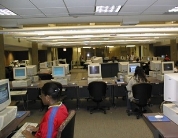
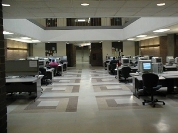
By 1998, I had deployed 13 networked computer labs across the three-campus infrastructure. The photographs below document those facilities — the physical evidence of what was built.
 |
 |
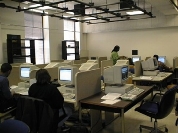 |
| Open lab, student workstations | Large open lab, students working | Full workstation deployment |
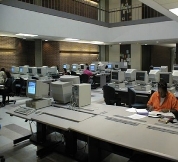 |
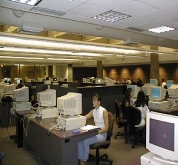 |
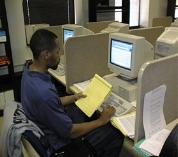 |
| Atrium-level lab | Individual workstation carrels | Large lab, full occupancy |
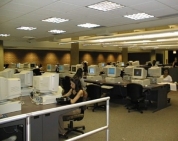 |
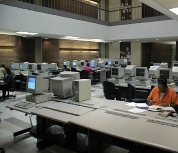 |
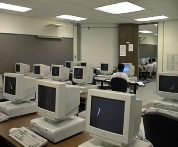 |
| Atrium lab, wide view | Networked workstation lab | Students at terminals |
Each of these steps was deliberate and documented. The disorder I had inherited was not the result of negligence — it was the natural result of a living system growing without coordinated information flow. The solution was the same one I had applied at Winthrop: move the institution from entropy toward order, systematically, with evidence at every step.
Executive Director of University Computing: 2000–2004
In 2000, my role was formally elevated to Executive Director of University Computing, with full responsibility for all IT functions across the institution. I assumed this position fully in January 2001.
As Executive Director, I led, coordinated, and supported the effective use of information technology for the University's instructional, research, and service missions across Administrative Information Systems, Academic Computing, Media Services, Networking and Distributed Services, Telecommunications, and the Help Desk.
Campus Infrastructure
- Planned and implemented the first campus Wi-Fi hotspot
- Planned and implemented the first live campus webcam
- Directed development of an RFP and project management for a high-speed OC-3 network connection providing access to the North Suburban Higher Education Consortium and the Illinois Century Network
- Managed replacement of VAX/UNIX/mainframe applications with in-house UNIX and LAN systems
Systems and Policy
- Led business reengineering, systems design, and project management of a student/faculty/staff Email and Internet Account Management System
- Directed specification development and implementation of the first Cisco communications server for campus dial-in access
- Oversaw development of the 2002 NEIU Web Publishing Policy
The NEIU World Wide Web page below documents my named role as a member of the Web Advisory Group, in collaboration with University Computing Services, in establishing and governing the university's web presence.
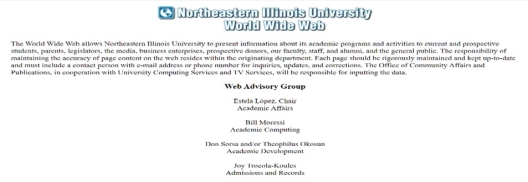
NEIU World Wide Web page — listing Bill Moressi, Academic Computing, as a named member of the Web Advisory Group responsible for governing university web content standards.
Teaching and Learning Environments
In 2002, in collaboration with a colleague, I presented the results of the Technology Enhanced Classroom initiative at the Emerging Building Technologies Conference in Las Vegas, Nevada:
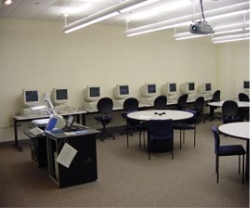
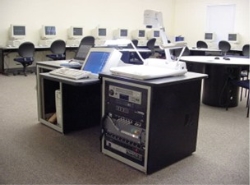
The photographs and floor plan below document Technology Enhanced Classroom FA104 — one of the student-centered learning environments designed, constructed, and implemented under my direction.
 |
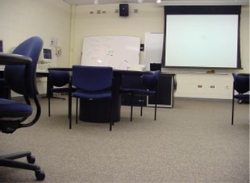 |
| FA104 — instructor station and workstations | FA104 — presentation area and seating |
 |
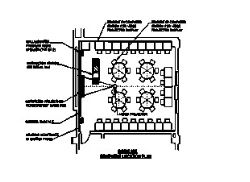 |
| FA104 — full room, round collaborative tables | FA104 — equipment location floor plan |
State-Level Service
- Served as a member of the State Universities Civil Service System IT Work Study Committee, reviewing and updating state IT personnel classifications across Illinois
The Result: From Fragmentation to Unity
The organizational chart below was reconstructed from publicly available institutional data on NEIU's current structure. It illustrates the unified, CIO-led University Technology Services that evolved from the foundational reorganization begun in 1995.
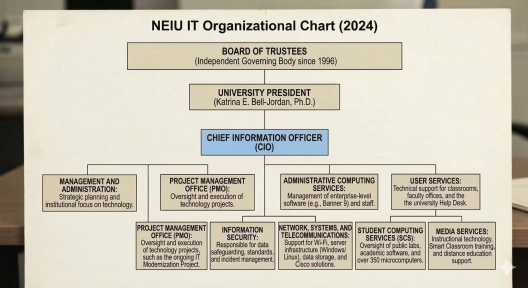
Reconstructed NEIU information-technology organizational structure, illustrating the unified CIO-led model that evolved from the reorganization begun in 1995.
The contrast between 1995 and the end of the 1995–2004 period is documented by the consolidation of previously separate technology responsibilities under University Computing, expansion of institutional technology services and infrastructure, and growth from one staff member to 50 full-time employees and more than 100 part-time student workers. The reconstructed chart above illustrates the unified CIO-led organizational model that evolved from that reorganization; it is not a verified 2004 organizational chart.
I did not hold the title of CIO. But I built the foundation on which that office was eventually established.
I started with one staff member. I retired with 50 full-time employees and more than 100 part-time student workers.
The Technology Transition in Context: 1995–2004
The nine years of my NEIU tenure coincided with the most dramatic transformation in the history of academic computing. When I arrived in 1995, the internet was a novelty. When I retired in 2004, it was the foundation of everything the university did.
The IBM 3090 mainframe gave way to distributed UNIX and LAN systems. Novell NetWare was superseded by modern network infrastructure. The ISIS student records system was a predecessor to the enterprise platforms that followed. Dial-up access gave way to the OC-3 high-speed connection I procured. CD-ROM research databases gave way to web-based journals. The first campus Wi-Fi hotspot I installed was the beginning of what is now a campus-wide wireless infrastructure.
Community Service
Beyond my institutional responsibilities, I engaged in community service that reflected my lifelong commitment to science education and public engagement.
North Park Village Nature Center
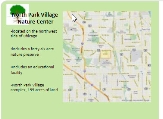
As a member of the Chicago Conservation Corps, I contributed volunteer service at the North Park Village Nature Center, managed by the Chicago Park District and situated adjacent to the NEIU main campus. The center encompasses a 46-acre nature preserve within the 155-acre North Park Village complex, offering woodland, wetland, prairie, and oak savanna habitats.
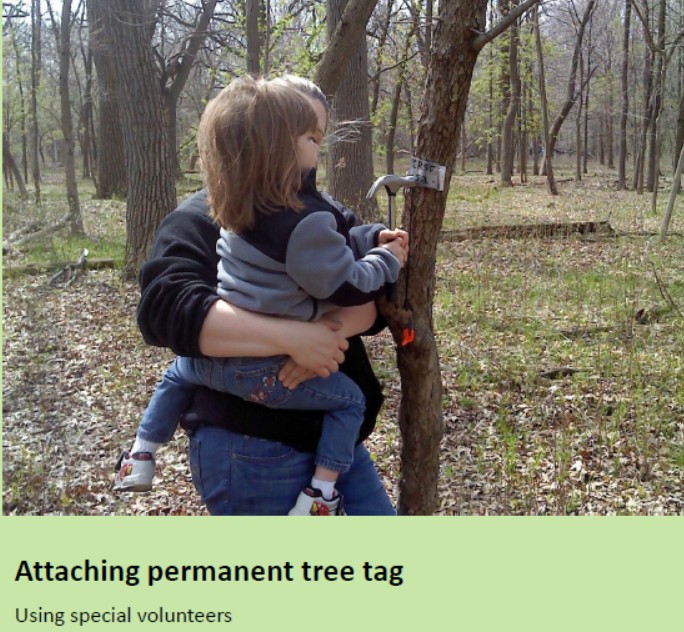
My work contributed to studies of urban tree demographics, examining how urban environments affect tree longevity, height, and growth patterns. The study involved hands-on tree tagging and systematic data collection in the field.
 |
 |
 |
| NPVNC location map, 46-acre preserve | Tree tagging study, winter fieldwork | Aerial map of tagged trees and perimeter |
St. Ignatius College Prep
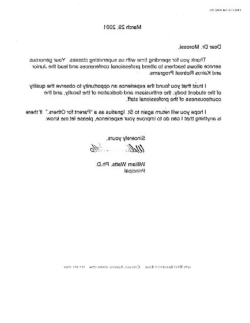
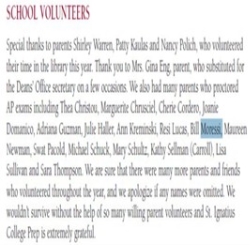
I served as a class supervisor, substitute teacher, and IT support resource at St. Ignatius College Prep, one of Chicago's distinguished Jesuit secondary institutions. My contributions spanned multiple years and were formally recognized by the school's administration on several occasions. Class supervision allowed faculty to attend professional conferences and lead the Junior and Kairos Retreat Programs. The central technical contribution, formally credited by Principal Carole J. Manning in February 2004, was the electronic duplication of eleven years of accumulated student medical records — paper files converted into structured, durable digital storage.
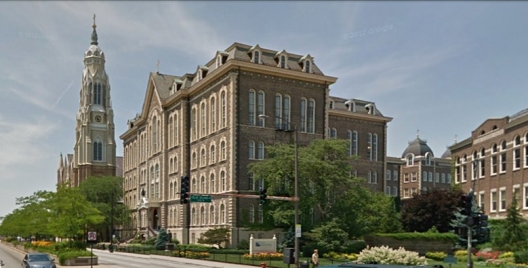
St. Ignatius College Prep, 1076 West Roosevelt Road, Chicago, Illinois.
 |
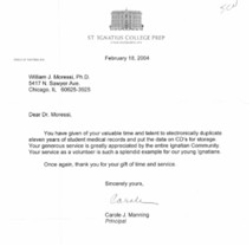 |
| Letter from Principal Watts, March 2001 | Letter from Principal Manning, February 2004 |
 |
|
| School newsletter — Volunteers citation | |
Chicago Public Schools Student Science Fair
During my NEIU tenure and continuing into retirement, I served as a volunteer judge for the Chicago Public Schools Student Science Fair — High Schools North Regional competition drawing student researchers from across Chicago's north-side high schools. Surviving documents confirm participation across five occasions spanning six years, 2002 through 2007, with my own written notation on the 2007 RSVP form recording approximately five or six total judging appearances. My son had also been a participant in the fair.
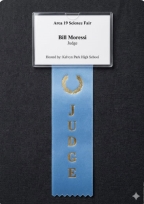
Judge credential badge and ribbon — Area 19 Science Fair, January 19, 2007, hosted by Kelvyn Park High School.
January 18, 2002 — High Schools North Regional Science Fair, Regions 1 & 2
Served as Exhibit Judge at the CPS High Schools North Regional Science Fair, held January 18, 2002. The fair program lists William J. Moressi, Northeastern Illinois University, among the Exhibit Judges. A follow-up letter dated February 21, 2002, from David Kaplan, Coordinator, formally thanked Dr. Moressi for his participation and noted that students received new ideas from the judges and applied them to their projects. The letter anticipated his return at the City Science Fair, March 22–24, 2002, at the Museum of Science and Industry.
January 31, 2003 — High Schools North Regional Science Fair, Areas 19 & 20 (at NEIU)
Invited by David Kaplan, Coordinator, via letter dated November 12, 2002, to judge the fair to be held at Northeastern Illinois University's Commuter Center, with judging from 1:00 to 4:00 p.m. following a buffet luncheon. Dr. Moressi returned the signed RSVP confirming attendance and lunch, assigned judge number 297. A December 31, 2002, letter confirmed his acceptance and judging assignment. His judge credential badge from the event, dated January 31, 2003, bears his name and judge number. A February 17, 2003, letter from David Kaplan formally thanked him for his participation, anticipating his return at the City Science Fair, March 21–23, 2003, at the Museum of Science and Industry.
January 2004 — High Schools North Regional Science Fair, Areas 19 & 20
A February 2, 2004, letter from David Kaplan, Coordinator, formally thanks Dr. Moressi for his participation in that year's fair and anticipates his return to the City Science Fair, March 25–28, 2004, at the Museum of Science and Industry. The specific January date of the 2004 fair is not preserved among the surviving correspondence.
January 21, 2005 — Area 19 & 20 Student Science Fair, North-Grand High School
Invited by Mark B. Wollschlaeger, Coordinator, via letter dated November 16, 2004. A subsequent letter dated January 10, 2005, notified judges of a venue change, relocating the fair to North-Grand High School, 4338 West Wabansia Avenue, Chicago, due to "complications beyond our control." The event program, themed "Grab the Power of Science and Mathematics," lists Dr. Moressi among the credentialed judges, with a judge badge reading "W. J. Moressi, Judge."
January 19, 2007 — Area 19 Science Fair, Kelvyn Park High School
Invited by the Judging Committee (RyAnn Nelson, Tom Unger, Tony San Agustine) to judge the Area 19 Science Fair at Kelvyn Park High School, 4343 West Wrightwood Avenue. Dr. Moressi submitted a completed RSVP Judge Information Sheet, listing his affiliation as NEIU (Retired) and selecting Computer Science and Health Science as his preferred judging categories. In response to how many times he had judged the fair, he wrote: "About 5 or 6 times." In response to the question of how he first heard of the fair, he wrote: "My son was a participant." The credential badge and Judge ribbon shown above is from this event.
Lincoln Park Zoo
Following retirement, I volunteered as a research assistant at Lincoln Park Zoo under Dr. Lisa Faust, then a leading population biologist at the zoo and creator of the PopLink software, which is used industry-wide to manage endangered-species demographic data. My work involved a comparative software audit — cross-loading a common studbook dataset into both SPARKS and PopLink under fixed extraction criteria, then analyzing the resulting divergence in mortality probability and at-risk population counts across multiple species. The analysis, using the White-nosed Coati (Narica) as a detailed worked example, documented measurable divergence between the two systems at key life-stage points — though the variability observed, given the modest sample size, pointed to the need for more data to achieve greater precision before drawing firm conclusions about software concordance.
Honors and Professional Recognition
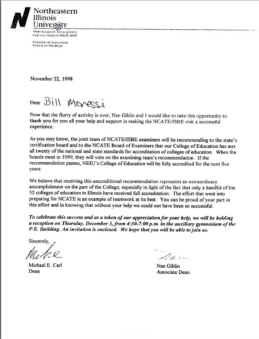
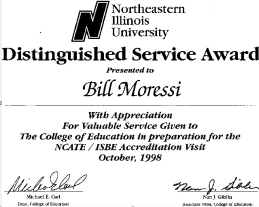
In November 1998, Dean Michael E. Carl and Associate Dean Nan Giblin of the College of Education wrote personally to acknowledge the role of Bill Moressi in achieving full NCATE/ISBE accreditation — one of only a handful of Illinois colleges of education to receive unconditional recommendation. This was accompanied by a formal Distinguished Service Award.
 |
 |
| Letter from Dean Carl and Associate Dean Giblin, November 22, 1998 — personal acknowledgment of role in NCATE/ISBE accreditation success |
Distinguished Service Award — Northeastern Illinois University, College of Education, presented to Bill Moressi, October 1998 |
In 1999, the Handicap Educational Liaison Program at NEIU presented a Certificate of Service for participation in Mayor Richard M. Daley's Summer Jobs Program, July and August 1999.
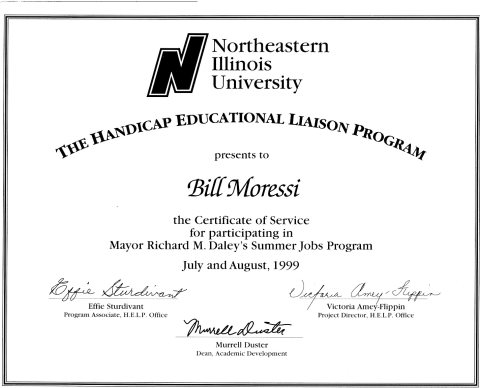
Certificate of Service — The Handicap Educational Liaison Program, Northeastern Illinois University, presented to Bill Moressi for participating in Mayor Richard M. Daley's Summer Jobs Program, 1999.
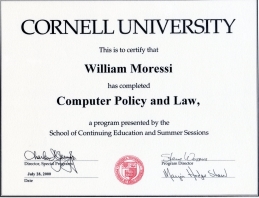
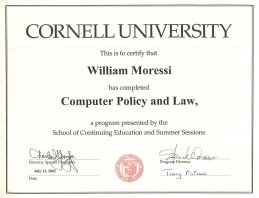
Advanced professional development was completed through the Cornell University Program in Computer Policy and Law, School of Continuing Education and Summer Sessions, in both 2000 and 2002.
 |
 |
| Cornell University — Computer Policy and Law July 28, 2000 |
Cornell University — Computer Policy and Law July 12, 2002 |
Upon retirement in June 2004, Northeastern Illinois University presented a crystal Service Award engraved with the university seal — a tangible recognition of nine years of service to the institution.
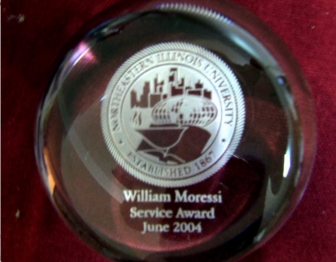
Northeastern Illinois University crystal Service Award — engraved "William Moressi, Service Award, June 2004."
Farewell
I retired from Northeastern Illinois University in 2004 after nine years. What I left behind was not merely a functioning IT department. It was a transformed institution — one with centralized governance, documented policies, modern infrastructure, and a trained professional staff capable of carrying the work forward.
The staff I worked with at NEIU were the best I had in my career. Saying goodbye to them was a bittersweet moment that I have not forgotten.
Forensic Summary: What the Evidence Demonstrates
I arrived at a fragmented institution and built, from one staff member, a unified IT division of 150 personnel. The organizational structure I created became the foundation for NEIU's current University Technology Services.
Every major technology infrastructure milestone at NEIU during 1995–2004 — the first UNIX host, the first campus network standards, the first Wi-Fi hotspot, the first webcam, the OC-3 connection, the Technology Enhanced Classrooms — was initiated or directed under my leadership.
The institutional IT policies I drafted and implemented — Acceptable Use, Copyright, Internet/WWW, Web Publishing, Contingency Recovery — established the legal and ethical framework within which NEIU's technology operations still function.
The approach I applied at NEIU was the direct application of a methodology I had developed, documented, published, and proven at Winthrop University between 1987 and 1995. The "Towards Negative Entropy" framework — diagnose the disorder, establish governance, implement standards, build infrastructure — was applied consistently across two major institutions over nearly two decades.
This is the evidence. The conclusions follow from it.
— William J. Moressi, 2025